



If someone had predicted that your highest-converting ‘store’ wouldn’t be a website or an app but a simple chat thread, you might have laughed. Now, WhatsApp is exactly that—an efficient, always-available storefront built into your customer’s daily habits, fully under your control.
Now, for millions of companies, WhatsApp is no longer just the place where customers ask, “Is this in stock?” It is where they browse products, ask for recommendations, get personalised deals, and even pay without leaving the app.
Let’s break down why WhatsApp commerce works so well, how the numbers stack up, and why the new pricing model can still work in your favour.
Why WhatsApp Feels More Like a Storefront
Open Rates That Most Marketers Only Dream Of
As of 2025, if you have ever run an email campaign, you know the feeling: you spend hours crafting it, hit send, and then see that the average email open rate across industries is around 42.35%. However, WhatsApp showcases a completely different story. Messages have a 98% open rate, which means almost every recipient sees your message. That is like having a shop where 98 out of 100 passersby at least glance at your display window.
Click-Through Rates That Crush Email
Getting people to open your message is one thing; getting them to act is another. On WhatsApp, click-through rates range between 45% and 60%. This is equivalent to handing out 10 flyers and having five people immediately walk into your store; something that does not typically happen with email marketing.
Conversions That Outpace Traditional Channels
Here is where it gets really interesting. WhatsApp marketing campaigns see 5%–15% conversion rates, compared to 1%–4% for traditional e-commerce.
In India, some brands are reporting a 25% uplift in conversions compared to standard online store checkouts. And when you nail the targeting and personalisation, you can achieve 45%–60% conversions or even higher. OXXO, a major Latin American retail chain, hit an 80% conversion rate by integrating WhatsApp with Salesforce CRM.
All this adds up to one clear point: WhatsApp is not just a channel; in fact, it’s a conversion engine.
Meta’s Recent Pricing Shift: What Changed and Why It Matters
A Move From Conversation-Based to Per-Message Billing
Until June 30th, 2025, WhatsApp charged businesses for a 24-hour session (a conversation), regardless of the number of messages sent. Since July 1, 2025, Meta has rolled out a new pricing model that has changed the way businesses are billed. Now, every message, whether marketing, utility, or authentication, is counted and charged individually, making WhatsApp much more than just a conversation tool.
Same Rates but Smarter Billing
While the billing model is changing, the actual pricing remains the same. WhatsApp will still charge the same rate per message that it earlier applied to entire conversations, based on geography and template category. The only difference is that billing will now be more granular, charging for each message instead of a 24-hour session, without any hike in the base rate.
Utility & Service Messages Still Free Within 24 Hours
When a customer messages you, a 24-hour window opens during which replies like support help, delivery updates, or confirmations are free. Send as many as needed without paying a rupee. For bulk utility messages beyond this window, tiered pricing applies, meaning the more you send, the lower the cost of each one becomes.
Volume Discounts Open the Door for Savings
Meta is introducing tiered pricing for Utility messages to make WhatsApp more cost-effective for high-volume transactional use. The more Utility messages you send in a month, the lower your per-message rate becomes, with discounts applied automatically based on usage. These tiers reset monthly and vary by country or region, making large-scale notifications such as ticket confirmations, order tracking, and appointment reminders more affordable.
What’s at Risk? Utility Templates Get Stricter
Starting from July 1, WhatsApp will have stricter criteria for approving Utility templates to ensure that the 24-hour free messaging window is utilised only for necessary, user-centric communication.
A Utility template has to satisfy two criteria:
- Non-promotional – The message must not be intended to sell or market anything. This includes avoiding upselling, discounts, special offers, promotional phrases, or calls to action that encourage extra purchases. It should purely focus on providing useful, relevant information to the customer without any sales intent.
- User-Requested Messages – The message must be something the customer has asked for or something essential for their account or service. This could be payment receipts, shipping updates, appointment reminders, important account information, or security alerts that keep their service running smoothly.
Any promotional element, even a subtle one, can cause rejection or reclassification as a marketing template (charged accordingly) and may lead to account restrictions. Meta has been reviewing content more closely since April 2025, and enforcement will get even stricter after July.
Putting It Together: Conversion Math Meets Pricing Strategy
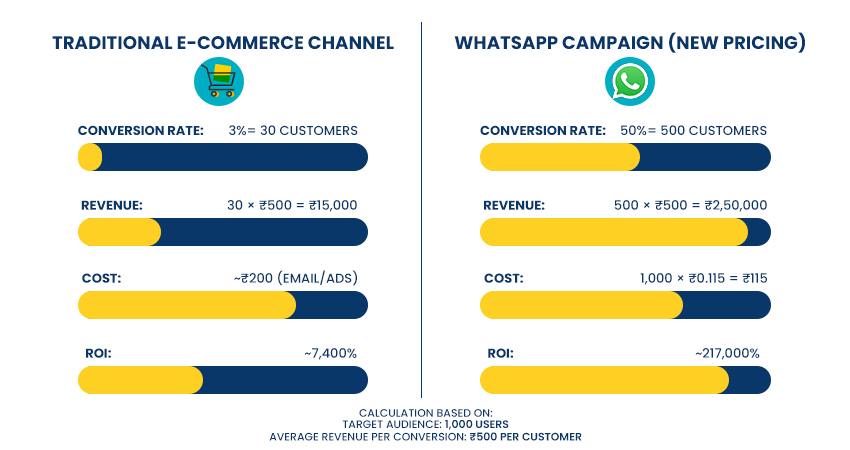
Strategic Takeaways: How to Optimise with New Pricing
1. Prioritise personalisation, not frequency
With every message now costing money, make it count. Use Meta catalogues or carousels to deliver tailored product suggestions that feel relevant and useful.
2. Use service flows strategically
Prompt users to start conversations (like “Reply HELP for status”) so you can send free 24-hour service messages for updates, confirmations, or quick follow-ups.
3. Bundle messages wisely
Avoid sending multiple messages a day. Combine updates and add CTAs in a single, well-crafted message to reduce costs and avoid spamming.
4. Audit templates now
Keep utility templates strictly functional. Any trace of promotion will turn them into billable items, so review and clean them up.
5. Track conversions meticulously
Add distinctive URLs or codes to WhatsApp messages and synchronise with your CRM to track engagement and sales influence.
Final Thoughts: Why WhatsApp Commerce Wins
There is a reason why people say “WhatsApp is the new storefront.” It’s personal, immediate, and remarkably effective as a sales channel. With open rates approaching 100%, CTRs exceeding 50%, and conversions ranging from 5% to a jaw-dropping 80% in real-world cases, WhatsApp isn’t just marketing; it’s commerce in conversation.
Yes, Meta’s recent shift to per-message billing forces businesses to rethink their approach, but it also rewards smarter, leaner, more meaningful engagement. Those who adapt, such as those who combine personalisation, automation, and strategic flows, stand to gain significantly.

